
Short answer
Waiving your inspection contingency does not mean skipping inspection — but it does mean you lose the contractual right to use later inspection findings to negotiate, terminate, or demand repairs after your offer is accepted. After closing, undisclosed-condition disputes are difficult and fact-specific, often turning on what the seller knew or represented. Whether waiving is reasonable depends on what diligence you have already done, how old and complex the property is, and how much financial cushion you have to absorb unexpected repair costs.
Why buyers face this decision in Greater Seattle
In a competitive offer situation — particularly when a listing has an offer review date or is generating multiple offers — sellers often prefer offers with fewer contingencies. An inspection contingency gives buyers the ability to terminate or renegotiate after inspection, which sellers view as uncertainty. Buyers facing competition may feel pressure to waive the contingency to strengthen their position.
In recent years, especially in 2021 and 2022, waived inspection contingencies became common across many Greater Seattle submarkets. With more inventory and longer days on market in some segments, inspection contingencies are now more viable in a wider range of situations. The decision is more nuanced: waiving is not a requirement in most negotiations, but it still comes up for homes with offer review dates or in competitive price bands.
Three inspection options buyers should understand
Before deciding whether to waive, it helps to separate three distinct things buyers often conflate:
Inspection contingency: A clause in your purchase and sale agreement that gives you a negotiated period to have the property professionally inspected and negotiate based on findings, or terminate under the contingency terms. The exact deadline and remedies come from the contract.
Buyer pre-inspection: You hire and pay for an independent inspection before writing your offer. If you do a buyer pre-inspection, you know what the inspector found before you commit. Some buyers then waive the inspection contingency in their offer because they have already completed their own diligence. The cost is real and you have no guarantee of winning the home.
Seller-provided pre-inspection: The seller commissions an inspection before listing and makes the report available to prospective buyers. This report is produced for the seller, not the buyer. Washington courts and real estate professionals have noted that a seller's inspector's obligation runs to the seller, not to the buyer — meaning a buyer typically has no direct legal claim against the seller's inspector if the report missed something. The report can still be informative, but it is not a substitute for a buyer-commissioned inspection.
Main risks when waiving without your own inspection
Post-closing recourse is limited and fact-specific. After closing, your ability to seek recourse for undisclosed defects is limited and often depends on what the seller knew, what the seller represented, and what the buyer could have discovered during diligence. An undiscovered problem that no one knew about is very different from a known condition that was misrepresented.
The listing's cosmetic condition does not indicate system condition. A renovated kitchen and fresh paint do not tell you about the electrical panel, crawlspace drainage, sewer line, or roof. In Greater Seattle's older housing stock — particularly pre-1980 construction — cosmetic updates can exist alongside systems that have not been touched.
Sewer line risk is material on many Seattle properties. Seattle Public Utilities notes that property owners are responsible for maintaining the side sewer line from the home to the public main in the street. On older properties with large trees or no recent sewer scope, waiving inspection without a separate sewer scope means absorbing that risk without data.
Earnest money is at risk. If you waive the inspection contingency and then discover a serious problem you did not anticipate, your options are limited: proceed, renegotiate if the seller agrees, or walk away — potentially forfeiting earnest money. Consult with your agent and attorney about the specific contract terms in your situation.
What I check before recommending waiving without a buyer pre-inspection
As a buyer's agent, these are the questions I want answered before a buyer considers waiving the inspection contingency without their own pre-inspection:
Has a buyer pre-inspection been done? If yes, and the inspector found nothing material, the risk is meaningfully lower. If no, the buyer is relying on the seller's report or no report at all.
Is a seller pre-inspection available, and what did it find? A seller-provided inspection that found only minor items is a different situation than no inspection at all. But I treat it as one data point, not as complete diligence, because the scope was set by the seller, not the buyer.
Is Form 17 available and reviewed? Washington's seller disclosure statement (Form 17) requires sellers to disclose known material defects. If Form 17 has not been delivered, or if it includes disclosures about systems, permits, water intrusion, or structural work, I want those addressed before recommending a waiver. Note: buyers retain a rescission right for a period after receiving Form 17, but buyers should confirm the current terms with their agent or attorney as these rights are contract- and timing-dependent.
What is the home's age and construction type? Homes built before 1980 in Greater Seattle carry higher risk categories: galvanized plumbing that may have degraded, older electrical panels, drainage and crawlspace conditions that can be difficult to assess from a listing, and sewer lines that have had decades of tree root exposure. These are not automatic deal-breakers, but they are reasons why a buyer pre-inspection adds real value.
What is the buyer's cash reserve after closing? If a buyer is stretching their budget to close and has minimal post-closing liquidity, an unexpected repair — a failed sewer line, a drainage issue, or an electrical panel upgrade — could create significant financial stress. Waiving inspection is most defensible when the buyer has the capacity to absorb a repair without financial hardship.
Riskier scenarios for waiving
- Pre-1980 construction with no seller pre-inspection and no buyer pre-inspection
- No Form 17 available before the offer deadline
- Large trees visible near the home and no sewer scope documented
- Evidence of prior moisture, water intrusion, or remodeling work in listing remarks or photos
- Buyer has minimal post-closing cash reserve
- The home's major systems — HVAC, roof, electrical, plumbing — are undisclosed or unknown age
Lower-risk scenarios for waiving (relative to the above)
- Buyer has completed a pre-inspection with an independent inspector before writing the offer
- Seller has provided an inspection report and Form 17, both reviewed and showing only minor items
- Property is a newer construction (post-2000) with documented system ages
- Buyer has reviewed HOA documents for a condominium that includes exterior maintenance coverage
- Buyer has sufficient post-closing cash reserve to absorb unexpected repairs
Even in lower-risk scenarios, waiving an inspection contingency transfers risk from the seller to the buyer. The question is whether the risk has been meaningfully understood before the transfer.
Decision framework
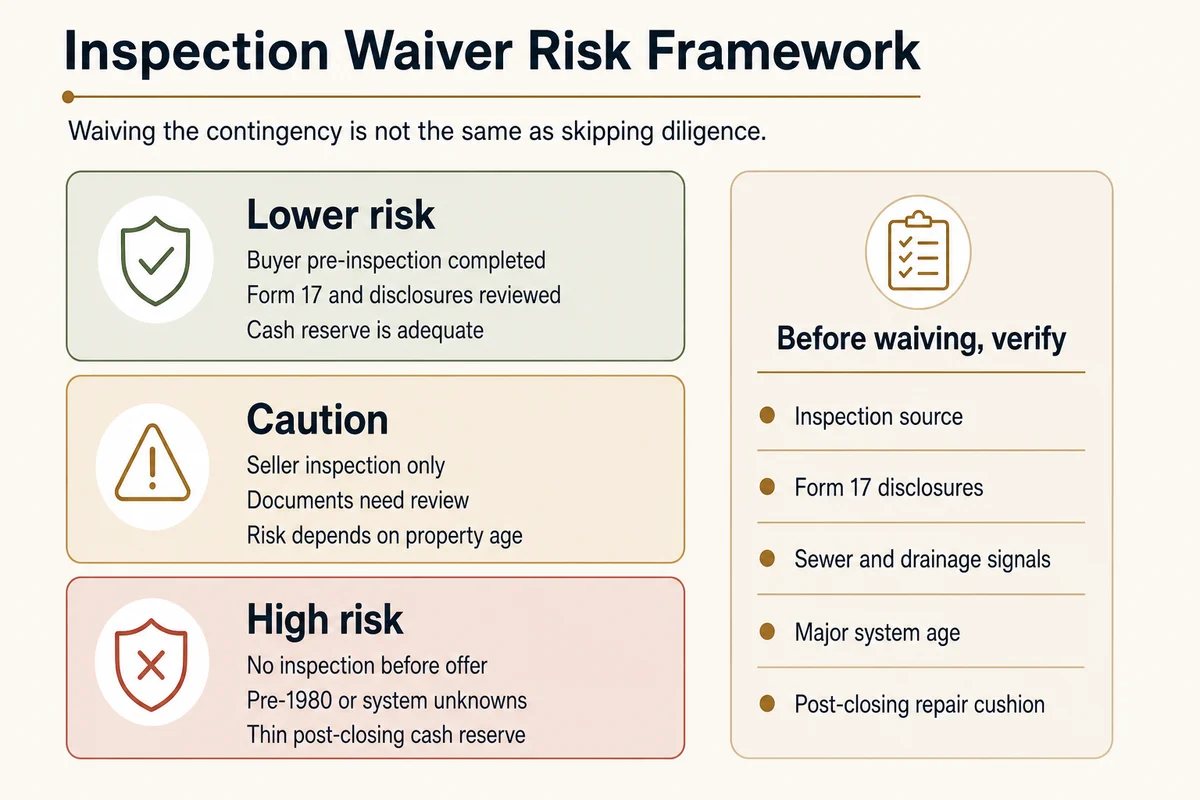
Is a seller pre-inspection or buyer pre-inspection available?
  ├── No → Waiving without any inspection means absorbing unknown risk.
  │        Is the home pre-1980 or does it have visible condition signals?
  │          ├── Yes → Waiving is high-risk. Consider buyer pre-inspection if timeframe allows.
  │          └── No → Still assess: Form 17 reviewed? Cash reserve adequate?
  └── Yes (seller inspection available)
        ├── Did inspection find material issues? → Understand what they are before deciding.
        └── No major findings → Has buyer reviewed it? Is Form 17 also available?

Is Form 17 available before your offer deadline?
  ├── No → You are writing under incomplete disclosure. Factor into your decision.
  └── Yes → Review it. Any disclosures about water, permits, systems, or structural work?

What is buyer's post-closing cash reserve?
  ├── Minimal → Waiving is higher risk regardless of property age.
  └── Adequate → Risk is still present but buyer has capacity to respond.