
Short answer
Bellevue, Redmond, and Kirkland are three Eastside cities that first-time tech buyers often compare when they want proximity to major Eastside employers and have a budget ceiling around $1.5M.
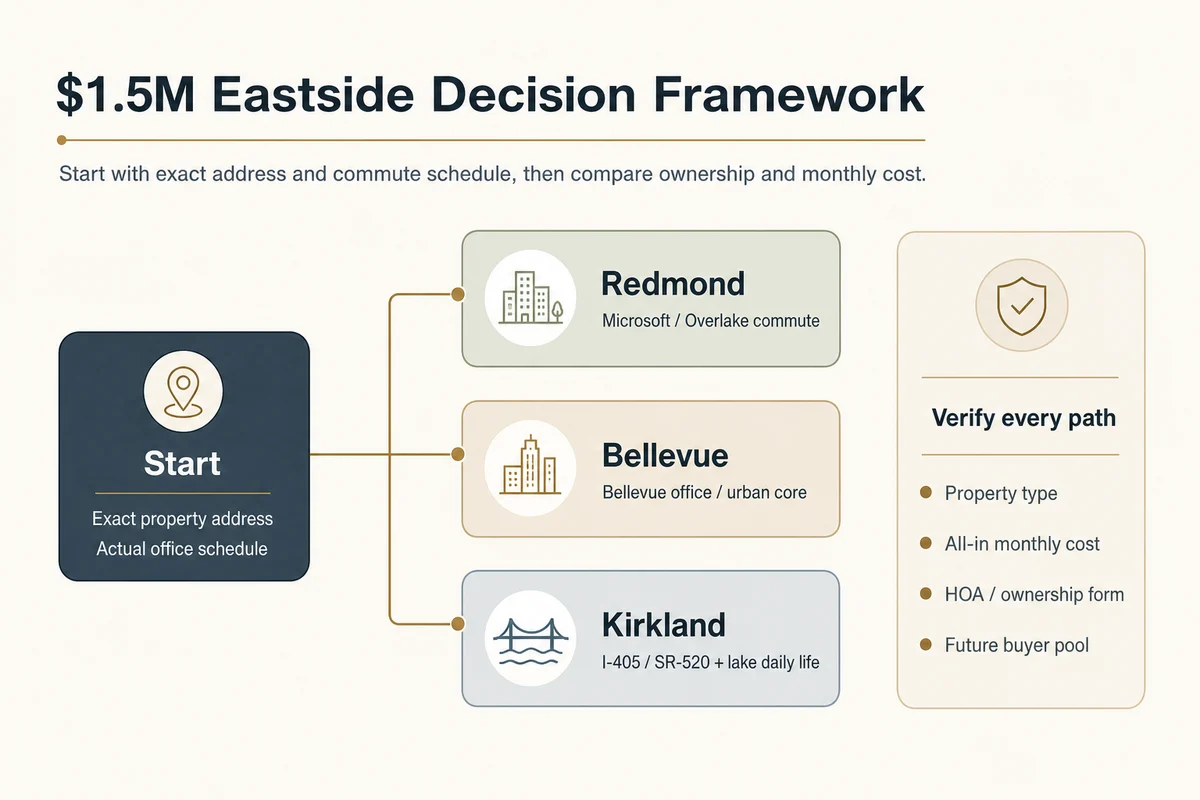
Use the city name as the starting point, not the conclusion. A useful comparison looks at specific properties based on your workplace, commute method, property type, all-in monthly cost, HOA or ownership structure, and expected holding period. Under $1.5M, the practical question is not just "which city?" — it is what property type and tradeoffs you are actually buying in each city at the time you search.
Who this comparison is for
This comparison is for buyers who are genuinely deciding among Bellevue, Redmond, and Kirkland because their work, commute, budget, and property-type preferences could make more than one city plausible.
It is especially relevant for first-time buyers who are financing the purchase, have a budget ceiling around $1.5M, and are comparing condos, townhomes, and single-family homes rather than assuming one property type from the start.
If your primary commute is to downtown Seattle or South Lake Union, the same framework still applies, but the commute analysis changes: every Eastside option needs to be tested against cross-lake commute time, transit access, parking, and your actual work schedule.
Price point reality under $1.5M
Citywide medians are a rough context signal, not a shopping plan.
As of Redfin's March 2026 city pages, Bellevue's median sale price was approximately $1.5M, Redmond's was approximately $1,397,500 (about $1.4M), and Kirkland's was approximately $1,375,000 (about $1.4M). Those figures mix property types and submarkets — condos, townhomes, and single-family homes at different price points in different neighborhoods — so they do not tell you what is available under a specific budget in a specific submarket right now.
For a buyer under $1.5M, the better question is: what property types and tradeoffs exist within each city at the time you are searching, and what does each option actually cost per month?
| City | What under-$1.5M buyers should verify |
|---|---|
| Bellevue | Which property types — condo, townhome, or specific SFH submarkets — appear in current MLS inventory under your ceiling; how HOA dues, parking, and all-in monthly cost fit the budget |
| Redmond | Whether available options are condos, townhomes, or single-family homes in the current MLS inventory; how proximity to the relevant workplace or transit route varies by neighborhood |
| Kirkland | Which submarket and property type are actually available under the ceiling in current inventory; how I-405/SR-520 access, HOA structure, parking, and maintenance obligations affect the comparison |
Verify current inventory with a buyer's agent and current MLS data. City-level medians change quickly, and the mix of what is available at a given price band changes with it.
First, define the property types you are actually comparing
City names do not determine property type. Under $1.5M in any of these cities, you may be comparing condos, townhomes, single-family homes, or a mix. Before comparing cities, confirm:
- Is the property fee-simple, condo-form, or part of a planned unit development (PUD)? This affects what documents you review, who maintains what, and what lender project review applies.
- Does the property have HOA dues? And if so, what do they cover — and what does the owner still pay for separately?
- What is the property's condition? A newer townhome and a 1965 single-family home are different diligence requirements at the same price.
Do not assume property type from city name or price band.
Commute tradeoffs by employer
For tech buyers, commute should be tested from the exact property address to the exact workplace, at the actual time you expect to travel.
Redmond may be more relevant for buyers commuting to Microsoft or Overlake-area workplaces. Bellevue may be more relevant for buyers commuting to downtown Bellevue or nearby office clusters. Kirkland can be practical for some Eastside commutes, but I-405, SR-520, neighborhood access, parking, and transit connections can change the result significantly by specific property location.
For downtown Seattle or South Lake Union commutes, all three cities require a cross-lake commute by car or transit. As of the March 2026 Crosslake Connection opening, Sound Transit describes the full 2 Line as connecting Lynnwood City Center and Downtown Redmond through Seattle and the Eastside. Buyers should verify current service alerts, schedules, station access, transfers, and walking distance from the specific property — transit relevance depends heavily on how close the property is to a station.
The practical test: run the door-to-door commute check for each specific property you are comparing, using your actual schedule and travel mode.
Monthly cost comparison: what the price tag does not show
Two homes can share the same purchase price and still create very different monthly obligations.
A $1.3M condo with substantial HOA dues and a $1.3M single-family home with no HOA will not have the same carrying cost. The condo's dues may include building-level expenses such as insurance, common areas, utilities, or reserves. The single-family home may have lower or no monthly dues but more direct responsibility for maintenance, repairs, utilities, and future system replacement.
For each property, calculate: mortgage payment + property tax + HOA dues + homeowner's insurance + utilities + parking + a maintenance reserve. The total is the real monthly cost, not the list price. Buyers should confirm property tax amounts through the King County Assessor for the specific parcel.
Common mistakes I see tech buyers make
Comparing cities before comparing actual property types. A buyer may think they are choosing between Bellevue, Redmond, and Kirkland, but under a specific budget they may really be choosing between a Bellevue condo, a Redmond townhome, and a Kirkland older single-family home. Those are different financial and diligence problems.
Treating office distance as the same thing as commute quality. A property can be geographically close to an employer and still have a frustrating commute because of last-mile traffic, parking, freeway access, transit transfers, or a hybrid schedule that changes how often the commute matters.
Overweighting pre-approval and underweighting post-closing cash. Tech buyers with RSU income can look strong on paper while still being exposed to appraisal gaps, tax withholding, stock-price movement, or a thin emergency reserve after closing. A comfortable purchase price should leave room for the first year of ownership, not just the down payment.
Assuming school boundaries from city name. School assignment is address-specific. Do not assume that a Bellevue, Redmond, or Kirkland mailing address tells you the school assignment or that a third-party school rating answers the question you care about.
Ignoring HOA and ownership form because the home is newer. A newer townhome can still have a thin reserve, unclear exterior responsibility, rental restrictions, insurance questions, or condo-form ownership that affects lender review. Newer does not mean document-light.
Daily-use tradeoffs
Instead of asking which city has the "better lifestyle," define the daily pattern you want and test it against specific properties.
Bellevue may appeal to buyers who want proximity to a denser commercial core, transit stations, office buildings, walkable retail, and urban services. Redmond may be relevant for buyers who want proximity to Microsoft/Overlake, Redmond Town Center, bike corridors, or newer mixed-use areas. Kirkland may be relevant for buyers who value access to Lake Washington, downtown Kirkland, Totem Lake, Juanita, or I-405/SR-520 connections.
These are not rankings. They are prompts for a buyer to test against specific listings, commute patterns, and daily routines.
School boundary note
If school assignment matters to your decision, verify the specific property address using the relevant school district's official boundary tool. Do not rely on listing descriptions, neighborhood assumptions, or third-party ratings without understanding their methodology and current boundary data. School boundaries are parcel-specific and can vary within a neighborhood.
Future resale considerations
Future resale is property-specific. Instead of assuming a city or property type will resell well, look at factors that can narrow or widen the future buyer pool: property type, ownership form, HOA health, financing eligibility, layout, parking, condition, commute access, price band, and recent comparable sales.
A condo with building-level financing or HOA issues may have a narrower buyer pool. A townhome with awkward layout, limited parking, high HOA risk, or poor exterior maintenance may also have a narrower buyer pool. A single-family home still requires property-specific diligence on condition, location, layout, and comparable sales. Do not treat city name alone as a resale strategy.
The useful resale question is: if you had to sell this exact property in three to five years, who would the likely buyer be, what would they compare it against, and what might make their lender, inspector, or budget say no? That question produces better judgment than asking whether one Eastside city is "better" than another.
Questions to ask yourself
Commute
- Where exactly do you work, and what does the door-to-door commute look like from each specific property at your actual travel time?
- How often will you make that commute, and does the route work for your real schedule?
Property type
- Are condos, townhomes, and single-family homes all real options for you, or do your needs narrow the comparison?
- Is the townhome fee-simple, condo-form, or part of a PUD? Does the ownership form affect your diligence or financing plan?
Monthly cost
- What is your comfortable all-in monthly payment — not just the mortgage pre-approval ceiling?
- How do HOA dues, insurance, utilities, taxes, and maintenance reserves change the comparison between specific properties?
Holding period
- How long do you expect to own the property?
- What future buyer-pool constraints might apply to that specific property type and building?
Household needs
- Do other household members have commute, accessibility, transit, space, or daily-routine requirements that should be part of the decision?